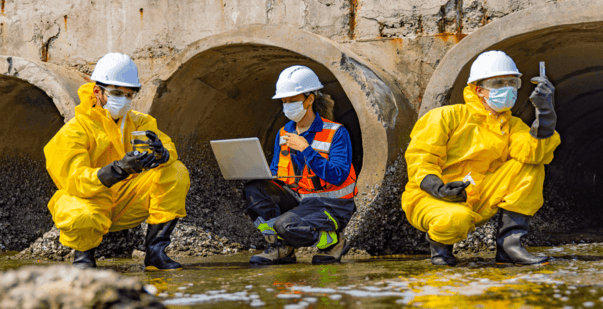
That raises an important question: Do environmental consultants need HAZWOPER training? And if so, which level?
The answer depends less on your job title and more on what you actually do on the job, how often you work at hazardous waste sites and your potential exposure to hazardous substances.
OSHA's Hazardous Waste Operations and Emergency Response standard, commonly known as HAZWOPER, establishes training requirements for certain workers involved in hazardous waste operations and emergency response. For environmental consultants, the appropriate training can range from no HAZWOPER requirement at all to 24-hour or 40-hour initial training plus annual refresher training.
Here’s how to determine which level may apply to your role.
What Is HAZWOPER Training?
HAZWOPER refers to OSHA's Hazardous Waste Operations and Emergency Response standard, found in 29 CFR 1910.120 for general industry, with corresponding requirements under 29 CFR 1926.65 for construction.
The standard covers several types of work involving hazardous substances, including certain:
- Cleanup operations at uncontrolled hazardous waste sites
- Corrective actions involving hazardous waste
- Operations at hazardous waste treatment, storage and disposal facilities
- Emergency responses involving hazardous substance releases
Not every employee who encounters hazardous material needs HAZWOPER training. The requirement depends on the type of operation, the employee's responsibilities and the potential for exposure.For environmental consultants, that distinction is particularly important because two people with the same job title may perform very different work.
24-Hour versus 40-Hour HAZWOPER: What's the Difference?
For hazardous waste cleanup operations, OSHA generally separates workers into categories based on their responsibilities and potential exposure
| Training |
Generally applies to |
Field experience |
|
24-hour HAZWOPER
|
Certain occasional site workers performing limited tasks who are unlikely
to be exposed above permissible exposure limits; also certain regular
workers at fully characterized sites where exposures remain below those limits
|
At least 1 day of supervised field experience |
|
40-hour HAZWOPER
|
General site workers whose work exposes or potentially exposes them
to hazardous substances or health hazards
|
At least 3 days of supervised field experience |
|
8-hour refresher
|
Workers covered by the initial HAZWOPER cleanup-site training requirements
|
Annually |
|
Supervisor training
|
Managers and supervisors directly responsible for covered hazardous
waste operations
|
Additional specialized training may apply |
These distinctions come directly from OSHA's HAZWOPER requirements. OSHA specifically identifies groundwater monitoring and land surveying as examples of limited tasks that can fall under the 24-hour category when workers are unlikely to experience exposures above applicable limits.
That makes the 24-hour versus 40-hour distinction especially relevant to environmental consulting firms.
When Might an Environmental Consultant Need 24-Hour HAZWOPER Training?
The 24-hour HAZWOPER course may be appropriate for environmental professionals who only occasionally enter a covered hazardous waste site to perform a specific, limited task and are unlikely to be exposed above permissible or published exposure limits.
Examples could include consultants conducting:
- Groundwater monitoring
- Land surveying
- Certain environmental sampling activities
- Site inspections in characterized areas
- Limited environmental assessments
- Data collection in areas with controlled exposure conditions
OSHA specifically cites groundwater monitoring, land surveying and geophysical surveying as examples of occasional site activities that may fall into this category.
However, simply being on-site occasionally does not automatically mean 24-hour training is sufficient. Employers must evaluate the actual hazards and expected exposure associated with the work.
When Might an Environmental Consultant Need 40-Hour HAZWOPER Training?
The 40-hour HAZWOPER course generally applies to workers performing activities that expose or potentially expose them to hazardous substances and health hazards at covered cleanup sites.
For an environmental consultant, this could include more extensive involvement in:
- Hazardous waste site investigations
- Contaminated soil or groundwater remediation
- Hazardous substance removal activities
- Remediation oversight in potentially hazardous areas
- Fieldwork where exposure levels are uncertain
- Work requiring respiratory protection because of hazardous substance exposure
OSHA requires general site workers in this category to complete at least 40 hours of off-site instruction plus three days of supervised field experience before being considered fully trained for their assigned work.
There's another important consideration: a worker who initially qualifies for 24-hour training but later becomes a general site worker or is required to wear a respirator must receive additional training and supervised field experience to reach the 40-hour level.
A simple way to think about it
24-hour HAZWOPER:
“My work at the site is limited, the hazards are characterized and significant exposure isn't expected.”
40-hour HAZWOPER:
“My work puts me in areas where hazardous substance exposure is possible or I'm actively involved in hazardous waste cleanup operations.”
This is a helpful starting point, but the employer should make the final training determination based on actual job duties and site conditions.
What If You're Mostly an Office-Based Environmental Consultant?
Being an environmental consultant does not automatically mean you need HAZWOPER training.
For example, someone who primarily performs:
- Environmental reporting
- Regulatory research
- Data analysis
- Permitting support
- Sustainability consulting
- Environmental compliance documentation
- Remote project management
may not fall within HAZWOPER's covered operations at all.
The key question isn't “Am I an environmental consultant?” It's “Does the work I perform fall within an operation covered by OSHA's HAZWOPER standard?”
If you're unsure, your employer's health and safety team can evaluate your responsibilities, the sites you visit and the potential hazards involved.
What About Environmental Project Managers and Supervisors?
Managers and supervisors can have additional requirements.
Under OSHA's cleanup-site provisions, on-site managers and supervisors who are directly responsible for employees engaged in hazardous waste operations generally need the same initial training and supervised field experience as the employees they supervise, plus eight additional hours of specialized training related to the employer's safety and health program.
For environmental consulting firms, this can affect project managers, field supervisors and other employees responsible for overseeing teams at hazardous waste sites.
Do Environmental Consultants Need an 8-Hour HAZWOPER Refresher?
If your role is covered by OSHA's HAZWOPER cleanup-site training requirements, initial training isn't the end of the process.
Covered workers must complete eight hours of refresher training annually. The refresher should reinforce relevant material from the initial training and address developments, incidents and other topics relevant to the employee's work.
If your refresher deadline has already passed, that doesn't necessarily mean you automatically have to repeat the entire 24- or 40-hour course. OSHA says the employer should evaluate the employee's familiarity with relevant safety and health procedures and the employee should take the next available refresher course.
How to Determine Which HAZWOPER Training You Need
If you're an environmental consultant trying to choose between 24-hour and 40-hour HAZWOPER training, start with your actual job responsibilities.
Ask:
- Will I work at a site covered by HAZWOPER?
- Am I only visiting occasionally for a specific, limited task?
- Could my work expose me to hazardous substances above established exposure limits?
- Will I be working in an area where respiratory protection may be required?
- Am I participating directly in hazardous waste cleanup or remediation?
- Will I supervise employees performing covered hazardous waste operations?
If you're occasionally performing a limited task in a characterized, lower-exposure environment, 24-hour training may be appropriate.
If you're regularly involved in hazardous waste site activities with potential exposure to hazardous substances or health hazards, 40-hour training is more likely to apply.
And if your role changes, your training requirements can change with it.
HAZWOPER Training for Environmental Professionals
Environmental consulting can take professionals from the office to active remediation sites, industrial facilities and other potentially hazardous environments. Having the right training helps ensure workers understand how to recognize hazards, minimize exposure and work safely within their assigned responsibilities.
LearnTastic offers online HAZWOPER training designed to help professionals build the knowledge they need to work safely and meet applicable training requirements.
Read More - Explore LearnTastic HAZWOPER training courses








 Published Aug 11, 2026
 7 min read