





 Published Jul 7, 2026
 6 min read


OSHA 10 Certification Requirements by Industry: Construction Versus General Industry
Not sure which OSHA 10 certification you need? Learn the difference between Construction and General Industry training, who each course is for, and how to complete your OSHA 10 certification online.Starting a new job? Beginning an apprenticeship? Asked by your employer to complete OSHA 10 certification before your first day?You are not alone.One of the most common questions workers ask is:

Published Jul 7, 2026
Updated Sep 1, 2026
6 min read
Do I need OSHA 10 Construction or OSHA 10 General Industry?
The answer depends on where you work.
While both OSHA 10 courses teach workplace safety fundamentals, they are designed for different industries and cover different hazards. Choosing the right course helps ensure your training matches your job responsibilities and your employer's expectations.
This guide explains the differences, who each course is designed for, and why many workers choose to complete their OSHA 10 certification online.
What Is OSHA 10 Certification?
OSHA 10 certification is a common way people refer to completing the OSHA 10-Hour Outreach Training Program. Technically, OSHA 10 is not a certification program. After successfully completing the course, learners receive proof of completion and an official OSHA Department of Labor course completion card through the Outreach Training Program.
Topics include:
- Fall protection
- Personal protective equipment (PPE)
- Electrical safety
- Hazard communication
- Walking and working surfaces
- Emergency procedures
- Worker rights under OSHA
After successfully completing the course, workers receive proof of completion and their official OSHA Department of Labor (DOL) wallet card through the Outreach Training Program.
Many employers, contractors, unions, and government projects require OSHA 10 training before employees begin work.
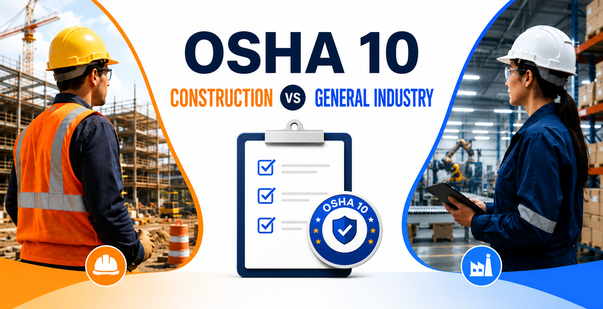
OSHA 10 Construction versus OSHA 10 General Industry
The biggest difference is simple:
Construction training is built for construction jobsites.
General Industry training is built for nearly every other workplace.
| OSHA 10 Construction | OSHA 10 General Industry |
|---|---|
| Construction sites | Manufacturing facilities |
| Roofing | Warehouses |
| Road work | Distribution centers |
| Commercial building | Retail |
| Residential construction | Healthcare |
| Electrical contractors | Hospitality |
| Plumbing | Property management |
Although both courses teach workplace safety, the hazards workers encounter every day are very different.
For example, construction workers spend more time learning about:
- Falls
- Scaffolding
- Ladders
- Excavations
- Heavy equipment
General Industry focuses more heavily on:
- Machine guarding
- Ergonomics
- Hazard communication
- Fire prevention
- Industrial workplace safety
Which OSHA 10 Course Do I Need?
If you are unsure, start with one question: Where do you spend most of your workday?
OSHA 10 Construction is typically right for:
- Construction laborers
- Electricians
- Roofers
- Carpenters
- Plumbers
- HVAC installers
- Equipment operators
- Road crews
- Concrete workers
- Apprentices entering the trades
If your work takes place on active construction sites, this is likely the course your employer expects.
OSHA 10 General Industry is typically right for:
- Manufacturing employees
- Warehouse associates
- Distribution center workers
- Production technicians
- Maintenance staff
- Healthcare support workers
- Retail employees
- Hospitality workers
- Facilities teams
If you work indoors in an industrial, commercial, or healthcare setting, General Industry is usually the correct choice.
Read More - Explore the LearnTastic OSHA 10-Hour General Industry Training to learn more.
Quick Industry Guide
| Industry | Recommended Course |
|---|---|
| Construction | OSHA 10 Construction |
| Roofing | OSHA 10 Construction |
| Plumbing | OSHA 10 Construction |
| Electrical | OSHA 10 Construction |
| Manufacturing | OSHA 10 General Industry |
| Warehousing | OSHA 10 General Industry |
| Healthcare | OSHA 10 General Industry |
| Retail | OSHA 10 General Industry |
| Hospitality | OSHA 10 General Industry |
| Property Management | OSHA 10 General Industry |
Do OSHA 10 Requirements Vary by State, Employer, or Industry?
Yes. While OSHA 10 is widely recognized, the exact requirement can vary depending on where you work, who you work for, and the type of project.
Federal OSHA does not require every worker to complete OSHA 10 training. However, OSHA 10 is often required by:
- State or local laws
- Public works contracts
- General contractors
- Employers
- Unions or apprenticeship programs
- Project owners or jobsite safety policies
This is especially common in construction. Some states and local jurisdictions require OSHA 10 Construction training for workers on certain public works or construction projects. For example, requirements may apply to publicly funded projects, projects above a certain dollar amount, or workers in specific construction-related roles.
Employer rules are often stricter than federal requirements. Even when OSHA 10 is not required by law, a company, contractor, union, or apprenticeship program may still require workers to complete OSHA 10 before starting work.
Why Many Workers Choose to Complete OSHA 10 Online
For many workers, getting certified is just one more thing to fit into an already busy schedule.
Online OSHA 10 training makes it easier to complete the course at your pace, when you have the time, without attending an in-person class.
Benefits include:
- Learn at your own pace
- Start and stop whenever your schedule allows
- Access the course from your computer, tablet, or smartphone
- Review lessons before moving on
- Complete training from home or anywhere with an internet connection
Many first-time learners also find that online training reduces pressure because they can spend more time on topics that are new to them.
How to Get OSHA 10 Certified Online
Step 1: Choose the correct course
Select either Construction or General Industry based on your job and employer requirements.
Step 2: Enroll in an OSHA-authorized course
Choose a provider that offers OSHA-authorized Outreach Training and a learning experience that fits your schedule.
Step 3: Complete the required training
Finish all course modules and assessments. Most learners complete the training over several sessions.
Step 4: Receive proof of completion
After successfully completing the course, you can access your same-day certificate while your official OSHA DOL wallet card is processed and mailed.
What to Look for in an Online OSHA 10 Course
Not every online course provides the same experience. Before enrolling, consider more than just the price.
Look for a course that offers:
- OSHA-authorized training accepted by employers
- Self-paced learning
- Mobile-friendly access
- Automatic progress saving
- Easy-to-follow lessons
- Responsive customer support
- Same-day proof of completion
- An official OSHA DOL wallet card after successful completion
A quality course should make it easy to focus on learning, not figuring out how to use the platform.
Why Learners Choose LearnTastic
The LearnTastic OSHA 10 courses are designed to make required safety training simple, flexible, and approachable.
Learners appreciate features such as:
- Self-paced online learning that fits around work and family schedules
- Mobile-friendly access so you can learn from almost anywhere
- Automatic progress saving, allowing you to stop and resume whenever you need
- Clear, easy-to-follow lessons focused on practical workplace safety
- Same-day digital certificate after successfully completing the course
- Official OSHA Department of Labor wallet card mailed after completion
Whether you need OSHA 10 Construction or OSHA 10 General Industry, LearnTastic makes it easy to complete your training with confidence.
Get Started Today
Choosing the right OSHA 10 certification does not have to be complicated.
If you work on construction sites, the LearnTastic OSHA 10-Hour Construction Course provides training designed for the hazards construction workers face every day.
If you work in manufacturing, warehousing, healthcare, retail, hospitality, or another non-construction industry, the LearnTastic OSHA 10-Hour General Industry Training is likely the right fit.
Whichever course you choose, you can complete your training online, learn at your own pace, and gain the safety knowledge needed to start your next job with confidence.
Frequently Asked Questions
Federal OSHA generally does not require every worker to complete OSHA 10 training. However, many states, municipalities, public works projects, employers, contractors, unions, and apprenticeship programs require OSHA 10 as part of their safety or jobsite requirements. Requirements can vary by location, industry, role, and project, so it is best to confirm with your employer or the organization requiring the training.
The OSHA DOL wallet card does not have a federal expiration date. However, some employers or states require workers to retake training every three to five years.
Yes. OSHA-authorized online providers allow you to complete OSHA 10 training at your own pace from almost anywhere.
Yes. Employers generally accept online OSHA 10 courses when they are provided through an OSHA-authorized Outreach Training provider.
The course includes 10 hours of required training. Because online courses are self-paced, many learners complete the material over several days instead of all at once.
See What Professionals Like You Are Learning Now
Related Blogs






Unlock Opportunities in Healthcare
Boost your Healthcare Credentials With Our Flexible Course







All content Copyright 2026 © - LearnTastic. All rights reserved.